Tuesday, March 22, 2011

Return to the Land of Eng

Last Thursday, I once again embarked upon my nine hour, six train journey back to Chesham, England from Dol de Bretagne, France with an over-abundance of luggage. Overall, it was a really great experience and though they drove me crazy sometimes, I will miss my French family. I am glad to know that I will always have a place to visit in France! We all cried the day I left and spent time the night before taking some "family portraits" but already in our pajamas! The day before I left, I made them American-style chocolate chip cookies à la Nestlé Tollhouse (which always reminds me of the Friends episode where Monica tries to figure out Phoebe's grandmother's recipe!) and they were a big hit! Really, chocolate, butter, and sugar? How can that not be good?

My "family" for the last (almost) three months!

As I was making my way through the Gare du Nord in Paris to get the Eurostar (Chunnel Train under the English Channel) to London, I walked toward a machine to print out my ticket. As I approached the machine, I saw a familiar face...Sonia from my gym in Fort Collins! She was on Spring Break in Paris with her boyfriend. We definitely "went all American" and screamed when we saw each other because it was just so incredibly random!

It made me really happy to suddenly get to speak English with someone I know from home!! I LOVE random connections like this! One time during college, I met the cousin of a high school friend on a train in Italy. Wonder what my next random meeting will be?


So, because I am trying not to spend any money since I don't have a job, I spent the weekend at home catching up on nerdy BBC tv (like Antiques Roadshow, I really am a nerd, I am aware!) and reading an amazing book called "Cutting for Stone" that I highly highly recommend. But, my computer was still broken so I had an appointment at an Apple Store in London for Monday. I figured since I had to spend the money to get to London (the tube is like £8 ($12 ish) each way, I should make the best of the day and be a tourist! It was a beautiful spring day (first day of spring, actually!) and so instead of going to museums, I decided to just walk around outside. Plus, I had a friend with me, Felix.

Felix is a rabbit who is a character in a children's book and he writes letters to his owner from his travels around the world to teach kids about geography. My friend Kendra's daughter, Haley, is reading about Felix and they asked me to take pictures of Felix in my travels. So, since it was beautiful and warm out, Felix and I decided to see the major sights of London.

Felix prefers land lines. He is kind of old-fashioned.

Don't even ask why I randomly had a roll of tape in my bag. I'm a teacher, we just carry school supplies sometimes!

Felix and Big Ben.

"Look Felix, Parliament. Look Felix, Parliament."

Felix ran away in St. James' Park (he is a rabbit) because the flowers were so beautiful!

Felix at Buckingham Palace.

Felix totally stormed the gates at Buckingham Palace. He was screaming something about trying to see the Queen- I think he was a bit carried away.

This was driving around in front of Buckingham Palace. Huh?

Felix kept trying to make the Queen's House Guard laugh...they were not amused.

This was just such a perfect London view.

I know I should be more mature. I'm just not.
This sculpture looked like a baby projectile vomiting.
It is really giggle-worthy and there were lots of kids standing around laughing at it (Oh, and me- probably why I like being a middle school teacher!)!

Queen Victoria outside of Buckingham Palace.
I haven't seen this part of London since I'd been in India- so very similar!
The Brits really did just try to rebuild England in India.

Since I was going to be in London all day, I figured, why not just go super early in the morning and wait for cheap, front row tickets to Wicked, my favorite musical.

I've seen Wicked a few times already but I still totally cried and had goose-bumps for half of the show. I'm such a loser, I am well aware. It was funny to hear all of the songs I know so well sung with English accents! Aren't I doing a great job of saving money???

So, now, after my one big day out, I am back to staying home and visiting the public library and nerd tv on the BBC. Next Monday I fly to Düsseldorf to see my new school and to see my new apartment! Yes, I have found an apartment! YAY!! This apartment will be perfect for visitors if anyone wants to start planning a visit! Felix is really excited about going to Germany! I hope he speaks some German because I sure don't but will start learning soon!

Saturday, March 12, 2011

A visit to the Débarquements de Normandie

Yesterday I visited Normandy and took a guided tour of many of the sites associated with World War II and the allied attacks on the Germans. Before I start, though, I would like to dedicate this post to my Papa, my mom's father, who arrived on Omaha Beach on Dday + 3. (According to our oral family history but I am trying to do some more investigation of that online.) I know it is cheesy to do that but I thought about him a lot yesterday and what his life must have been like for those four years he was in the army. He never really talked about it, according to my mom and her siblings, but he got to see it all again in 1978, which I can imagine was quite difficult.

James E. Handley
Technical Sergeant
U.S. Army July 1942- January 1946
820th Ordnance Base Depot Company

These pictures are not in order of our stops but I am still not proficient at using blogger after all this time to get the pics in an order I want. Anyway...sorry if you are reading this and think that I am over-explaining common knowledge- I didn't know a lot of this stuff and so if it is new to me, maybe it is to others as well.

The following three pictures are from Omaha Beach. I am by no means a historian but I feel like I should at least try to offer a little context for the pictures. So, if I have made any major faux-pas in my captions, please let me know so that I can correct them!
Hillside facing the beach with a German sniper hole.
The hills were quite steep just behind the beach.

Another sniper hole on the hillside.

Everything has been cleared off the beach and it just looks like a normal beach now.

Omaha Beach:
-Omaha was an allied code name. I guess I knew that somewhere in my brain since it is not a word in French, but all of the beaches in the area had code names in the planning. However, now, they are all referred to by their code names.
-There were around 3,000 American casualties from the attack launched on Dday- June 6, 1944. (This was the scene at the beginning of Saving Private Ryan.)
-The tides go out very far at this beach and they had to come in at low tide because the Germans had placed many obstacles and mines on the beach that would have been covered at high tide. They, therefore, had to come in very far from the various landing crafts that dropped them off- sometimes in deep water and so they just drowned immediately with the weight of their gear.
-Many injured soldiers died when the tide came in after the initial attack from drowning.
-The German guns were supposed to have been knocked out by planes in advance of the attack but there was low cloud cover and they were unable to hit the correct targets- thus leaving the arriving soldiers in the position of "sitting ducks." The hillsides are very high next to the beach and because they had to come in so far because it was low tide, the American soldiers were easy targets from the hill.
-Once the allied forces took control of the beach a large amount of men unloaded here within a short time. As most people know, June 6, 1944 is considered Dday (which I didn't know until yesterday just means "Day Day" and it is just military speak for whatever day is the attack day- in French it is Jour J which literally just means "Jour Jour")
-I don't normally believe in this kind of stuff, but Omaha Beach really did have an eery kind of feel. As our guide pointed out, there are no shells on the beach, no seagulls, and apparently they get some weird, unexplained red sand that looks like blood. People don't use Omaha Beach as a beach. It has bad juju.

American Cemetery at Omaha Beach:
The next set of pictures are from the American Cemetery just above Omaha Beach. It contains only WWII dead and mostly just from the DDay battles and ensuing attacks. There are around 9,000 Americans buried here and it is closed to new burials. There are other allied and American cemeteries in the area but this is the main American one. If you've ever been to Arlington or any other national cemetery, it is similar in format, but the thing that is different is that it is from a short period of time. Also, it overlooks Omaha Beach and it is on foreign soil, which is technically American on the spot.

Our guide stated that approximately 60% of the visitors are French and in his words, "The French have not forgotten." It might have just been for the benefit of all of the tourists who visit the area, but if I went by what I saw in Normandy, the French indeed have not forgotten. American flags (as well as Canadian and English at the allied sites) flags were everywhere. When my parents took my grandparents to France in 1978, some old women came up to my Papa and hugged him when they found out he had been a US Army soldier.


This was a piece of a tile mosaic on the ceiling of the non-denominational (including Jewish) chapel.

As I walked around, I noticed that many of the graves had this date.
Graves included the soldier's name, rank, unit, death date, and state but no age or birth date.
I wonder if they left those off because it would have been too shocking to see that so many of them were kids.

American flag at the cemetery.


All of the information is given in English and in French.

Jewish soldiers had a Star of David on their grave instead of a cross.

Many soldiers' bodies were found without any identification.
There was also a whole wall of names for the men whose bodies were never found but whose names were known. It was a big wall.

This is the main monument with a reflection pond.
Within the monument are carved granite maps explaining the liberation of France by the allies.
Everything is, again, in both English and French.

From every angle these graves are in a straight line.
This statue is called "Spirit of American Youth" and is a man rising from waves/water.

Arromanches:
We also visited the site of the allied "floating harbor." This was just down the coast from Omaha and Utah beaches.
-Arromanches was liberated on DDay +1 by the British but the town was very heavily bombed.
-The allied forces constructed a massive artificial harbor out of floating concrete blocks surrounded by a breakwater of old, sunken warships.
-As always in this area, tides were a huge issue and so they had to construct something that would work in both low and high tides.
-This floating harbor was only operational for a short time because after about 18 days in use, the worst storm in about 40 years hit the Normandy coast and so severely damaged it that it could no longer be used.

Parts of the floating harbor. These were called Mulberry A and Mulberry B.

Off in the distance, you can still see some of the concrete blocks.
They were about 200 X 50 feet so those don't just go away in 70 years.

Sainte-Mère-Eglise:
The reason I wanted to take a guided tour was to hear the little stories that I wouldn't get to know about otherwise because I would have been too busy trying to find my way around. Sainte-Mère-Eglise is a town inland from the beaches where soldiers from the 101st Airborne Division landed when they pretty much all jumped and landed at wrong spots because of the weather. One of the soldiers landed on top of the church and was caught there for days. He apparently played dead but was eventually cut down by the Germans but then escaped. I haven't seen it, but the movie "The Longest Day" is about this.

Also in front of this church was a ROMAN ROAD SIGNPOST! WHAT? How cool!
Makes you remember that really, Europe has a long history and the Germans were just another in a series of invaders.

They put a dummy on top of the church to show how the parachuter was stuck.

The windows in the church show the Virgin Mary with American paratroopers.

Angoville au Plain:
This was another one of those cool things that you'd only know about from a guided tour and it was really cool. We visited a tiny church in the hamlet of Angoville au Plain which only has about 50 residents. During the war, two 19-year-old American medics used it as a field hospital for several days for American, allied forces, Germans, and local civilians. The medics did not discriminate and cared only that the people were injured.

After it had been used as a field hospital, the doors were shut and locked. They were not opened until more than 50 years later when an old American man who had been a patient came to see it and basically just broke in. So, because it was closed all those years, it had some pretty amazing features.
These stains are ACTUAL BLOOD from wounded soldiers on the church pews.

The town decided, upon the anniversary of DDay in 2004, to recreate their church windows to thank the two medics for their service to the people of the town.

The medics were from the 101st Airborne Division.

People haven't forgotten.

Pointe du Hoc:
If you have ever seen the movie "Holes," this is what this area looks like. However, instead of holes dug by kids, they are giant bomb craters. Pointe du Hoc was a site occupied by Germans and was considered virtually untouchable because it has giant limestone cliffs leading up to it and all around it. It is a "point" of land out into the English Channel. An elite squad of American paratroopers trained for months on scaling cliffs in preparation for taking this point. However, they were dropped in the wrong spot, and were basically slaughtered by the Germans because they'd been detected climbing the cliffs.

Also, when the survivors got to the top, the mission had been for naught as the Germans had moved all of the weapons that they'd thought had been stashed there. They eventually found the weapons just inland and were able to destroy them.

You can't forget a war occurred less than 70 years ago when you see giant craters surrounded by concrete gun holes and gun stands.
The craters were about 10-15 deep.

This was a picture our guide had from during the war when the Americans had taken Pointe du Hoc.
I took the same view as the picture from above.
This is what it looks like today. Part of the actual point was bombed out and so it is no longer connected to the land.

Utah Beach:
Utah Beach was further down the coastline from Omaha Beach but the terrain in the area is very different. There are no bluffs overlooking the beach, it is virtually flat so there were not as many sniper opportunities. And, during the attack, it wasn't like with Omaha Beach on DDay where just about everything that could go wrong, went wrong.

The planes who were sent to pre-bomb the area were able to hit their targets because they could fly lower due to the lack of bluffs. So, more of the German guns were knocked out. Also, the tides are slightly differently timed here so the naval support from the seaside could be stronger and closer here. Interestingly, a Danish naval ship provided some of the support so there is a Danish war memorial here too. Utah Beach had only about 400 dead. Though that is a high number, compared to Omaha Beach, it is a fraction.

The feeling here was very different from Omaha Beach. I can't explain it. Utah Beach had different juju.
Utah Beach. Again, like Omaha Beach, just looks like a regular beach.

Naval Monument recognizing the contributions of the American and Allied Navies in providing fire support for the invasion.

I'm really glad I took this side trip. It was well worth the cost of a guided tour as I learned a lot and had context for everything I was seeing. It was definitely weird to be in a van full of Americans (especially because a few of them were total rednecks who had only been in France for three days but were complaining about how much they missed American food and that they just wanted a Big Mac-THREE DAYS???? WAY TO BE THE STEREOTYPE!). The real reason it was weird is because my brain hasn't adjusted to speaking English full time and French words kept popping out of my mouth. I doubt this will happen once everything around me is in English again, but while everything else is still in French, it was weird to speak English for a whole day!

So, now I am doing a little research to see if I can find out more about what my Papa's regiment actually did and where they were during the war. From what I can see they were in England, France, Belgium, and Germany and so it will be interesting to see if I can find the whole record.

À la prochaine....

I leave France to go back to England on Thursday.

Sunday, March 6, 2011

Subway Poetry

I'm not normally into poetry but I saw this poem on the tube in London and it really struck me. I even wrote it down quickly between stops so I could remember it.

So, here it is:

Loving the rituals that keep men close-
Nature created means for friends apart.
Pen.
Paper.
Ink.
The Alphabet.
Signs for the distant and disconsolate heart.

By Palladus (4th Century) and translated by Tony Harrison

Since it was written in the 4th Century, he couldn't have been able to include blogs, Facebook, email, and Skype. But, the sentiments are the same. Made me feel all warm and fuzzy.

I miss everyone!!

Friday, March 4, 2011

Le Mont Saint Michel...

Well, today I finally got to visit the most tourist-y place in my area, Le Mont Saint Michel. It holds special meaning for me because my parents took my grandparents (Nana and Papa) to see it in 1978. It has always been part of my family's folklore and it was just too far away when I lived in France during college to visit it. I did get a little veklempt a few times thinking about my family being here. It made me miss my Nana who would have had a birthday this week.

I'm sure next Friday when I visit the DDay beaches I'll be extremely emotional- for obvious reasons, and also because my Papa fought in the war and was in France. More on that later...don't need to get into it today!

Mont Saint Michel is an abbey dedicated to St. Michael, on top of a huge granite block out in the middle of the English Channel. It used to only be accessible when the tide was out but they have built a road that makes it accessible all the time. There are a few random giant granite hills around here and one of the other ones is just outside of Dol, my town. One thing I found amusing is that the sheep who graze on the grasses in the area are called "pre-salted" because they eat salty grasses and so their meat is really salty.

There's lots of medieval history that goes with this place but .....Wait. I just fell asleep. I know I should have more interest in medieval French/English history...I just can't. Sorry. The only person I know who has read "The Pillars of the Earth" is my friend Courtney and they were selling copies in the gift shops. So, maybe I'll see if that has anything to do with Mt. St. Michel by asking her because I just don't have enough interest otherwise! If you'd like a full historical work-up on Mt. St. Michel, you'll have to use Wikipedia.

Here's a link if you're interested. Wait. I just fell asleep again.


There's not too much to say...the pictures do the talking and I think I might have been able to upload a video at the bottom of this. Oh wait, I just got an angry error message in French...don't think the video worked...sorry! I have been waiting to visit because this would not be a fun activity in the horrible weather we've been having. We've got a few days of sun and so I am trying to pack everything in!

Let's start with the pictures...

This is a necessary picture after visiting the Taj Mahal.
I just can't help myself!


The Leaning Tower of Michel.
Had to do a timed self-portrait and I guess the rock I set my camera on was at an angle. But, I thought this was funny and wanted to show everyone anyway.
(This reminds me of a picture I have of my friend Sally and me in front of the Eiffel Tower in 1998- it is almost sideways! I'll have to find it and scan it sometime!)

Thank goodness for digital cameras.
I used to get way out of control with film cameras (like maybe took like 4 rolls of the Acropolis in Greece) and this is much more manageable and instant. I always hated waiting for pictures to be developed! It was horrible torture!

Pretty amazing.

The tide comes in and covers up the parking lots so cars have to be moved by a certain time.

Yep. I was here.

This is a famous restaurant in Mt. St. Michel.
My parents and grandparents ate here in the 70s.
I didn't eat here because it was like €40 for lunch, but I thought of Nana.

SENIOR PICTURE!!
I met a random older English couple while they were taking their own senior pictures!
We got to talking and they offered to take them for me too!
That's the worst part about traveling alone, nobody to participate in my ridiculous antics. (If there had been a giant shoe like in Amsterdam, I would have figured out a way...don't worry!)

Up at the top, in the abbey, you can see how far the tide really does go out- I think they said 28km or something.
I don't understand the metric system so I have no idea how far that really is!

Below the abbey are houses which are now hotels.
The people who live in Mt. St. Michel are called Montois.

Talk about high population density.
Everything is literally built on top of something else.

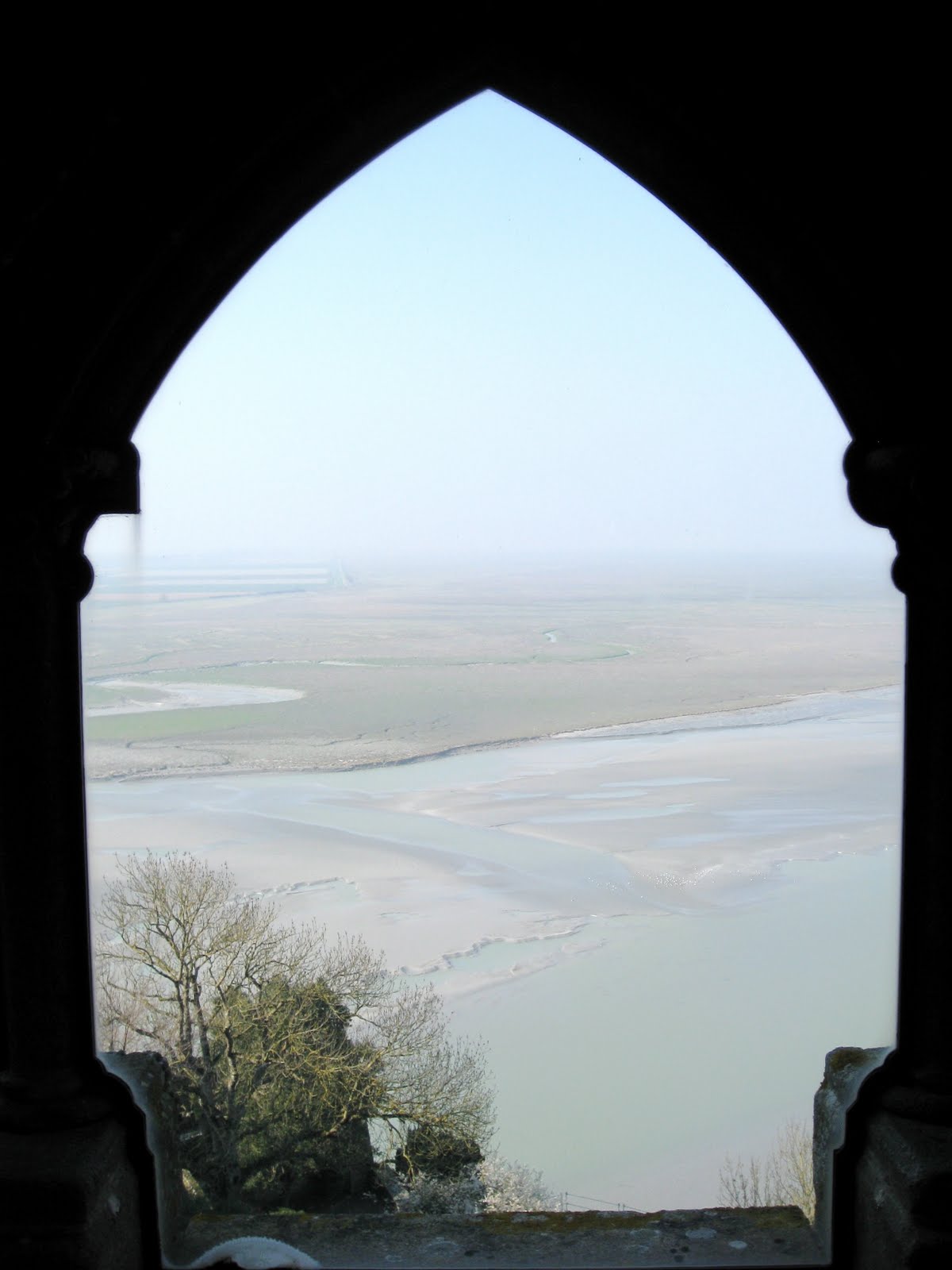
Some windows in the abbey.

This view is now glassed-over to protect stupid tourists from falling.
But, monks could have jumped out if they chose.

The Cloister at the abbey.
I'd like to be all smart and tell you what a cloister is, but I can't.
Oh, and I kind of don't care.

GORGEOUS!!!
In the summer there is a lot of muscle (Is this how you spell this type of creature? In French it is moules but that translates directly to mollusk so I don't know!), oyster, and other shellfish harvesting going on here. Update: My friend Nicole just informed me it is spelled "mussels." I'm a serious moron. I knew that, I swear.
Apparently, there also quicksand and the tides come in "faster than a galloping horse" according to the guidebook, so it is pretty dangerous to play in the area.

Looking back toward Dol. On a clear day, you can supposedly see it.
I believe it because I could see Mt. St. Michel from the other direction.

The causeway to get to Mt. St. Michel.
They are trying to change it to an elevated bridge so the natural tides can resume and the wetlands can be protected.

So, that was my day. I did meet a group of 8th graders from one of the international schools in London where I had an interview. They were all American kids and even before I heard them speak, it was obvious. I cannot really put my finger on it, but I could just tell. Made me excited for next year!

This weekend we are having 15 people over for Sunday lunch so I'll be making another cobbler and fattening up these skinny Frenchies! :) I made chili again, as requested. I thought it was crazy bland, but they all really like it!

I'm headed out of here two weeks from yesterday to go back to England. As much fun as I've had, I am getting a bit bored (nobody EVER wants to have English lessons- even the parents are whiny that it is too hard!) and so I don't really have a purpose anymore, per se. We've had two chickens die this week so my "purpose", as I see it, is to not get some weird poultry disease.


Monday, February 28, 2011

Motivation and "Drive" revisited

Last summer, while on a road trip, I listened to the book “Drive” by Daniel Pink. It was about intrinsic and extrinsic motivation and I was really struck by all that he had to say and how it related so wholeheartedly to schools. Well, in my life of unemployment in France, I have been looking for free ways to entertain myself when I am not playing the role of French housewife and was introduced to the website ted.com. I am now completely obsessed with TED talks, which are talks, given at a conference focusing on creativity and technology for smart, rich people…from what I can deduce.

The subject matter is incredibly varied and pretty much every researcher or writer that I enjoy reading, can be found at a TED conference. Everyone from Michael Pollan (The Omnivore’s Dilemma, The Botany of Desire) to Malcolm Gladwell (Blink, What the Dog Saw, Outliers) to Edward O. Wilson (biologist and ethicist) to Isabel Allende (amazing fiction writer) to Dave Eggers (writer and screenplay author) to James Watson (as in Watson and Crick- the discoverers of the double helix structure!) can be found giving talks that are extremely interesting. They also have talks given by politicians and policy makers, scientific researchers, comedians, etc. Literally, just about every person who I have looked up (except Bill Bryson but maybe they are saving him for the future) has had a TED talk and the last few weeks since I learned about TED, I cannot get enough. It is also searchable by subject matter and person and so I waste a lot of time here. But, I am not going to consider it wasted time, because I am learning so much.

I am probably way behind the times and everyone else has known about this forever. So, sorry if you already do. Introducing people to TED is not really the point of this, I just thought that I needed to give the background knowledge to set the context for the video and the ensuing discussion. Now, to get to the point…

I found a TED talk by Daniel Pink pretty much summarizing his book into about 20 minutes. So, if you don’t have time to read it, you MUST watch the video. I think that business people and educators alike will really be struck by what he has to say.

Click on the link below to watch the video:


Just to give some further information about the book and the concept, here is a repost of a few paragraphs that I wrote last summer regarding the book.

"Pink talks about how our traditional societal views of motivation are outdated. Prior to the industrial revolution, motivation was purely linked to survival and people’s actions were all in the name of satisfying basic needs. As our society became industrialized, and basic needs were being met, motivation became more related to extrinsic rewards/punishments like a salary, a boss micromanaging your every move, or fear of job loss. Eventually, extrinsic rewards/punishments became things like bonuses, commissions, and sales incentives, and I would think, in an educational setting, we saw the advent of letter grades and office referrals.

He equated these different types of motivation to Maslow’s Hierarchy of Needs (which we’ve all discussed frequently in pre-service teacher programs and don’t even get me started on grad school!). In the beginning, the survival motivation was like the bottom of Maslow’s Hierarchy. However, as we’ve developed as a society, we’ve moved up that pyramid, and we are now in the “self-actualizing” top portion. Because of this, Pink argues, the extrinsic reward/punishment motivation is no longer applicable in businesses and schools. The research has found that extrinsic motivators might work marginally in the very short-term, but over time, are ineffective. This sure is interesting when you consider schools are basically set up on an entire system of punishments and rewards- and mostly punishments when you really think about it.

The tasks that we are now asked to do in many jobs are not algorithmic tasks that simply require a pattern of repeated behaviors. For most of Western society’s large corporations, these tasks are the ones that have been outsourced. The modern workforce requires creativity and innovation and the research that Pink cites claims that our outdated extrinsic motivators actually stifle and dampen a person’s creative abilities and that we need to have a societal business/educational shift into intrinsic motivators. It is interesting to me that businesses require all of this creative thinking/tasks (Pink calls these "heuristic" tasks) and that in schools, we are still asking kids to do a lot of rote learning and trivial tasks. This idea is what really got me thinking about how this relates to classrooms and schools."

I read this book before spending the semester in an educational system that is largely driven my external factors, i.e. performance on a set of exams. And, I read it before spending the semester in a school that continued to just tell me to “give a detention” every time I had an issue with a kid. Like, literally any issue that I can think of, I was told to give a detention and if they didn’t show up, the detentions got increasingly longer and longer (sharpening the stick in the carrot/stick analogy). Well, it doesn’t take a book about motivation to see that these didn’t work but now that I have some time to reflect, I can see that the system as it stood was going against everything research shows about motivation. (Ironic since the head of the school had read the book himself and we discussed how much it really meant for the world of education…maybe his hands were tied in terms of systematic changes!)

Also, all those weeks that I was required to have kids memorize pointless information (the minutiae of the iron blast furnace, the molecular structure of cast iron vs. wrought iron, the exact chemical reactions in the thermal decomposition of limestone, someone else’s bullet points as to why stem cell research was right/wrong, the list could continue for just about the rest of time…) there were only extrinsic motivators out there- the giant exams at the end. And, for the population of kids with whom I was working, they lacked intrinsic motivation by the time they were at the end of secondary school and a “sweeter carrot” or a “sharper stick” just wasn’t making a difference at all.

The system was so rigid and so overly structured that it didn’t allow for teachers to actually help students create intrinsic motivation. When I tried to do something outside of the ordinary for my juvenile delinquent section of kids, I was told instead that I should just have them copy notes straight out of the book or worse yet...give them a word search. Really? Really. I think that we forget sometimes that kids are humans. And, something an adult wouldn’t be motivated to do, a kid is likely not going to be motivated either. I know that there are some tasks that people “have” to do and part of being an adult is knowing how to have the perseverance to get through them. However, when your entire educational experience becomes one long stream of “just get through it,” which it was for many of my students, that is when the problems occur.

I am not making a blanket statement that there isn’t intrinsic motivation (for learning in school, behaving appropriately, etc.) present in many students at the school where I was. All I am saying is for those who lacked it, there really wasn’t a way that the system allowed for any manipulation in order to create it. At my new school I will have the opportunity to and at CBMS, I was able to employ many strategies to create intrinsic motivation in students. (Not to mention, this is one of the main tenets of Love and Logic, which I pretty much have established through this blog that I could be their #1 salesperson!)

I was struck again by his three big ideas of Autonomy, Mastery, and Purpose and how true this is not only in business settings but also in schools. I actually have a business example and this person will know who they are, but I am not naming a name here.

A friend of mine worked in an office setting where her job description should have allowed her to have autonomy, mastery, and purpose but she was often given either relatively menial tasks or just not enough to do in general. Then, she was micromanaged in those tasks to the point where she wondered why she even bothered to do them and why the person micro-managing her didn’t do them. She is a really motivated and driven person in general, but this lack of autonomy, mastery, and purpose created in her a general malaise toward her workplace, her company, and she viewed her workday as just an annoying and very boring way to pass the time.

She expressed feelings of purposelessness in her professional life and tried on several occasions to make her bosses aware of her underutilization. To put it bluntly, she had no motivation to succeed in her company and not even much motivation to do a good job- although her upbringing and internal sense of what is right and ethical still made sure that she gave her best effort to the tasks she was given.

They FINALLY heard her. Some restructuring happened and now she is extremely busy and utilized at work and they have basically restored to her position autonomy, mastery, and purpose…and guess what…she is extremely motivated and has a renewed sense of her professional life.

Why can’t we do this for kids? What is stopping us? They "complain to their bosses" through misbehavior, lack of effort, and extreme malaise (not just general as was the case for my friend!). Life is short. Why do we make kids sit through at least 12 years and sometimes 16 years of non-engaging memorization? What purpose does this later serve society? I realize that I am fixated with this idea. But, the inane crap we ask kids to do that we would never want to do ourselves infuriates me. Oh, and then we punish them when they don’t want to do something we’d never do- further decreasing any chance that they might have some intrinsic motivation. We’ve got to make some changes and soon! Modern society and all of our futures will not wait. (For solutions, see the book “Focus” by Mike Schmoker).

This man found a way to genuinely motivate kids and I found it amazing and worth watching. Watch how these kids are learning…not memorizing because they are told to…because they are so genuinely interested in learning- when given autonomy, mastery, and purpose!

http://www.ted.com/talks/lang/eng/sugata_mitra_the_child_driven_education.html